SKU: 65404607678
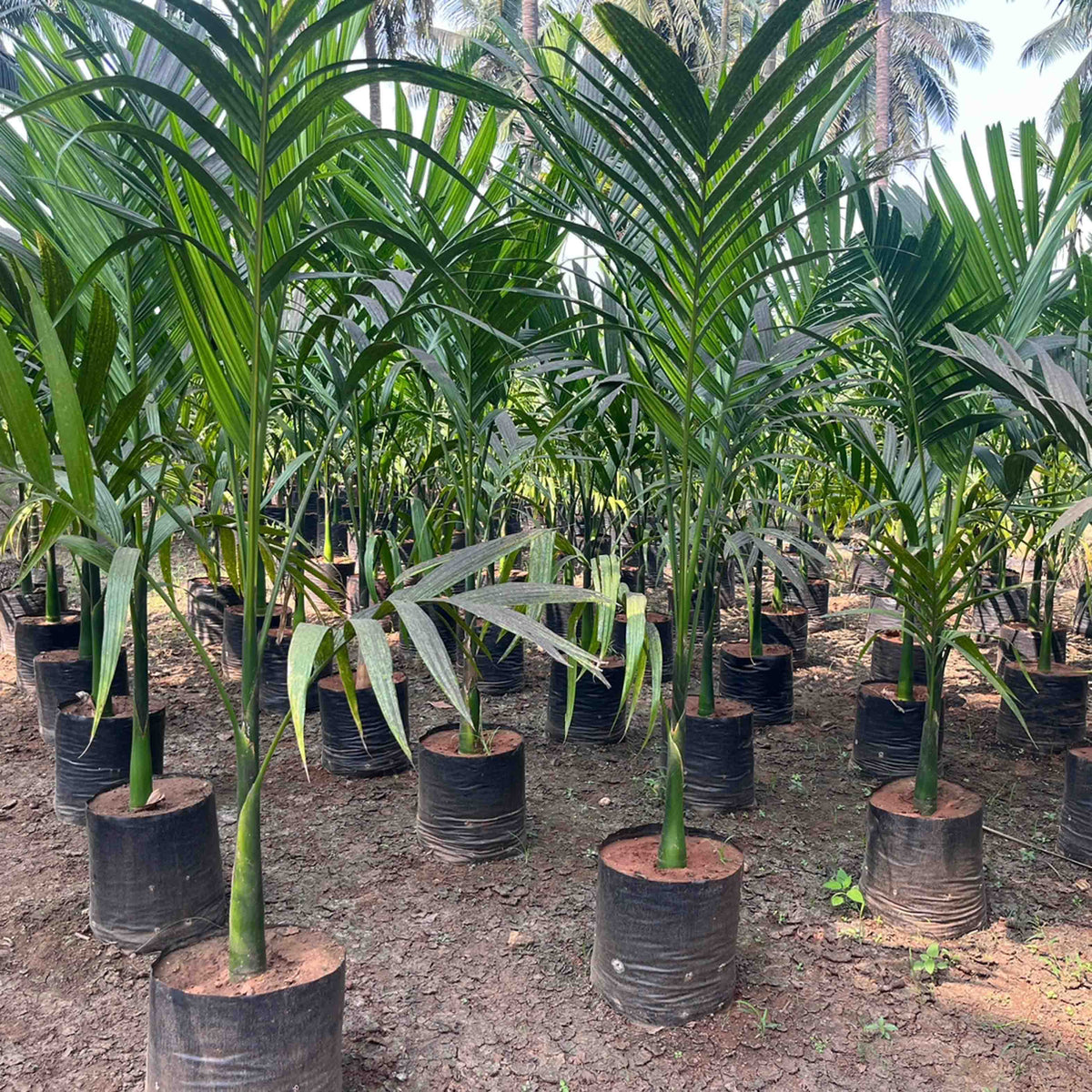
areca catechu palm

areca catechu palm Discover the Versatile Benefits of Areca Catechu (Betel Nut Palm) for — Saharanpur Nursery

Sale price$25.09 Regular price$27.88
Save 10%

Pay in installments of $6.97 with ShopPay, AfterPay and Klarna

Shipping Estimate
USA
  • USA
  • CAN

Ships within 48 hours · Estimated delivery Sep 26 - Oct 1

Promo Codes Available:

For Your Every Summer RSVP, with Code: SUMMER15

Description

areca catechu palm Discover the Versatile Benefits of Areca Catechu (Betel Nut Palm) for — Saharanpur NurseryCommon name: Betel Nut Palm, Betel Palm, Areca nut Palm,Bunga, Pinang, Jambe Regional name: Marathi Supari; Hindi Supari; Gujarati Supari; Kannada Adika; Tamil Pakku; Telugu Vakka; Malayalam Kamugu,Adakka, Sanskrit Poogiphalam, Category: Palms and Cycads, Fruit Plants, Trees Family: Palmae or Coconut family Introduction to Betel Nut Palm Tree The Betel Nut Palm (Areca catechu) is a species of palm tree native to tropical regions of Southeast Asia,

Common name:
Betel Nut Palm, Betel Palm, Areca-nut Palm,Bunga, Pinang, Jambe
Regional name:
Marathi - Supari; Hindi - Supari; Gujarati - Supari; Kannada - Adika; Tamil - Pakku; Telugu - Vakka; Malayalam - Kamugu,Adakka, Sanskrit - Poogiphalam,
Category:
Palms and Cycads, Fruit Plants, Trees
Family:
Palmae or Coconut family

Introduction to Betel Nut Palm Tree

The Betel Nut Palm (Areca catechu) is a species of palm tree native to tropical regions of Southeast Asia, specifically Indonesia, the Philippines, and India. It is commonly grown for its seeds, known as betel nuts or areca nuts, which are chewed for their stimulating and psychoactive effects.

Plantation of Betel Nut Palm Tree

  1. Choosing the location: Betel Nut Palms thrive in well-draining, fertile soil with a pH of 6.1-6.5. Select a site with partial to full sunlight exposure.
  2. Planting time: The ideal planting time is during the rainy season, as the soil remains moist and supports the growth of young plants.
  3. Spacing: Plant the seedlings at a distance of 6-8 meters (20-26 feet) apart to ensure proper growth and easy maintenance.

Growing Betel Nut Palm Tree

  1. Watering: Regular watering is essential during the first two years of growth. Maintain consistent moisture levels in the soil but avoid waterlogging.
  2. Fertilization: Apply balanced, slow-release fertilizer 2-3 times a year to provide essential nutrients for healthy growth.
  3. Pruning: Prune regularly to remove dead or damaged fronds and maintain the tree's shape.

Care for Betel Nut Palm Tree

  1. Pest control: Watch for common pests such as mealybugs, scale insects, and red palm weevil. Use insecticidal soap or neem oil for organic pest control.
  2. Disease management: Prevent fungal infections by providing adequate ventilation and avoiding waterlogged soil. Treat any signs of disease promptly with appropriate fungicides.

Benefits of Betel Nut Palm Tree

  1. Cultural significance: Betel Nut Palms hold great cultural importance in many Southeast Asian countries, where the betel nut is often used in religious and social ceremonies.
  2. Stimulant effects: Chewing betel nuts provides a stimulating effect due to its alkaloid content, which includes arecoline, a psychoactive compound.
  3. Medicinal properties: In traditional medicine, betel nuts have been used to treat various ailments such as digestive issues, respiratory problems, and even toothaches.
  4. Economic value: Betel nut production provides a source of income for many farmers in tropical regions.
Shipping Notes
  • Free Standard Shipping on $100+ Orders to the USA.
  • Except Preorder products are shipped in 48 hours.
  • Delivery to the USA:
  1. Standard Shipping : 3-10 business days
  • If time is of the essence, please consider selecting expedited delivery for faster service.
Exchange/Return Notes
  • We offer a 30-day return/exchange service after receiving.
  • Final sale items are not eligible for returns or exchanges.
  • To process your return/exchange, please contact us at [email protected]
  • Please click here for more details>>> Return & Exchange Policy
SKU: 65404607678

Discover Niche Categories That Outsell areca catechu palm

Top-Converting Item to Boost Your Average Order

4.5 ★★★★★
Based on 22 reviews
Sort
Highest Rating
Newest First
Oldest First
Product Reviews
T
Verified Purchase
T. S. Myers
Lowell, US
★★★★★ 5
Great Read
Format: Kindle
Very good book. I would recommend this to anyone who wants a well reasoned, easy-to-follow lay of the land when it comes to historical theology.
WAS THIS REVIEW HELPFUL?YesReportShare
Reviewed in the United States on September 30, 2025
J
Verified Purchase
Judi
Draper, US
★★★★★ 5
Worth the Money
Format: Hardcover
I bought this for a seminary class. I found it to be useful and a great resource for the future.
WAS THIS REVIEW HELPFUL?YesReportShare
Reviewed in the United States on November 26, 2025
E
Verified Purchase
E. Johnson
Lake Worth, US
★★★★★ 5
Worth the time, effort to get a good theological overview
Format: Hardcover
This book may be 600+ pages, making it a daunting task for the average Christian. But I recommend Olson's book because it gets the job done. If you want to have a good overview of the process of theology, this "story" is excellent. Written in a chronological fashion, Olson makes the facts come alive rather than mundane and dull as some other books have done. Yes, as one earlier reviewer said, Olson has his presupposions--which historian doesn't?--and his views do come out, like when he is talking about "fundamentalists" and "Calvinists." But is there really any way to write in a completely objective fashion? It's a pretty difficult task, and I think every historian I've read has his/her own opinions, meaning the recording of history is quite subjective. So I don't think it's as big of a problem as that reviewer believed it to be. My favorite part of the book was the first couple hundred pages. To me, it's obvious that Olson feels most comfortable with the first 5 centuries of the church, and this also happens to be my favorite part of church history to study. I had no qualms with how he presented everything, and the thorough index is a wonderful tool that I will probably use in the future as a reference book. All in all, I give this book a hearty thumbs-up. Just be patient and work your way through it, and you will be blessed.
WAS THIS REVIEW HELPFUL?YesReportShare
Reviewed in the United States on October 2, 2005
R
Verified Purchase
Russ White
Draper, US
★★★★★ 4
Great Foundational Book
Format: Hardcover
If you've ever wondered how the major pieces of Christian theology --things like the Trinity, Predestination, and Baptism-- you will find them here. Dr. Olson, a historian by trade, takes on the places, times, and movements that developed and hardened the Christian doctrines we know today. Essentially, this book follows a strictly chronological format, starting from the birth of the Church in the book of Acts, and carrying through to the split of the Fundamentalist movement and Reformed theology in the 20th Century. The first section deals with the fundamental heresies that came in with the founding of the Church by examining the writing of the Patristic Fathers, the Apologetic Fathers, and then focusing specifically on Irenaeus. Here the fundamental issues of the nature of Christ in his incarnation were initially resolved. Of course, many of these issues have risen again in recent time with the formation of heretical branches of Christian thought, such as the Jehovah's Witnesses and the LDS Church. The second section deals with the unity of the Church which is primarily founded on the conversion of Rome to a Christian state. While Dr. Olson does a good job of explain the good results of the unity of the Church, he doesn't cover the concerns of those Christians who objected to the sacralism of merging the state and church, and using state power to impose consistency of theology. The major argument over the nature of the Trinity is dealt with in the fourth section, and the fifth returns to the nature of Christ. Section five describes the split between the Eastern and Western church over the issue of the procession of the Spirit --does the Spirit proceed only from the Father, or from the Father and the Son. According to Dr. Olson, the theological quarrel was founded on different views of the place of Scripture and hermeneutics. Martin Luther, John Calvin, and the Reformers are covered in the seventh section. Dr. Olson provides good insight into the relationship between the various Reformers, laying the groundwork for the ultimate split of the Reformed movement described in section eight. The author's ability to lay out the relationships in this section provides a very easy to understand historical picture, though he tends to downplay the role and objections of the Anabaptists, and the sacralizing power grounded in Constantinian Christianity. In the final section Dr. Olson discusses the split between liberal and conservative Christianity, the split between fundamentalism and mainline Christianity. Some of the most interesting pieces he discusses here relate to the role of Billy Graham's ministry, and the role of various schools, strong personalities, and even the impact of scientific thinking in this era. A long read, but a good basis from which to reach out and investigate Christian history and theology.
WAS THIS REVIEW HELPFUL?YesReportShare
Reviewed in the United States on January 12, 2012
J
Verified Purchase
J.D. Jones
Omaha, US
★★★★★ 5
Great Read for "Emerging" Christians (Kindle edition)
Format: Hardcover
I have a lot to say which is positive about this book, but first let me say my one disappointment: In his review of theological development of the 20th century, he completely skipped over the pentecostal and charismatic movements. He spent lots of time discussing liberation and feminist theologies, but skipped over these massive movements which claim followers in the 100s of millions. This is surprising to me do to the author's pentecostal roots and the fact that he is a solidly evangelical theologian. It could be argued that these movements haven't introduce "new doctrine" but rather just a "new emphasis" on existing doctrines such as spiritual gifts or the Holy Spirit. True, but then why did he spend so much time discussing the Pietists for whom the same could be argued. The theological influence of the pentecostal and charismatic movements is significant and their omission is glaring. Other than that... This is a timely book, especially for younger Christians. So many "emerging" Christians are writing books and spouting off ideas which they take to be new and innovative. Reading this book shows you just how tiered they are. Reading Olson's chapter on the emergence of 19th century theological liberalism in Germany reminded me of the last Brian McLaren book I read. Same ideas, but but in the context of church history one realises that these "new perspectives" have already been tried and found wanting. Solomon's declaration that, "There is nothing new under the sun" is what rand through my ears when I considered what a lot of hip, trendy, "innovative" preachers are saying now-a-days. Olson's dealing with Catholic and Orthodox church history was fair and unbiased given that many evangelical protestants often are when writing about them. I personally learned a lot about both the Scholastics as well as the Pietists. I also valued his perspective on Augustine. It is a great one volume work. Also, unlike the other reviewer, my Kindle version worked just fine.
WAS THIS REVIEW HELPFUL?YesReportShare
Reviewed in the United States on November 26, 2010

recommand products